lunes, 2 de mayo de 2016

WHAT DO YOU KNOW ABOUT COLOURS?


Warm up activities....


1. Match the following sentences:

1. Blue is a…
a. emotions.
2. Red is a…
b. warm colour.
3. Colour schemes express…
c. use black and white in different proportions
4. Achromatic schemes…
d. harmonising.
5. Polychrome images…
e. have a single colour.
6. Monochrome images…
f. use neighbouring colours in the colour wheel.
7.Combining colours is called colors…
g. have two or more colours.
8. Related colour harmonies…
h. cold colour.

2. Work in pairs. Discuss these questions with your partner.
  • What is related color harmony? What is complementary colour harmony?
  • What is harmony of greys? Is it a warm range or a cold one?
  • Explain:
    • monochrome images
    • polychrome images
    • achromatic scheme
    • Hue
    • Value
    • Saturation

3. True or false? Correct the false sentences.
  1. Colours have five characteristics.
  2. Hue, tone and tint refer to the name of the color.
  3. Value is the luminosity of a colour.
  4. Value represents the amount of water in a color.
  5. A tone with a lot of white, has a low value.
  6. A tone with a lot of black, has a low value.
  7. Only primary colours are pure colours.
  8. We always perceive colors in the same way.
                                             COLOURS


Primary and secondary colours 

Colour is an element of visual language has been studied throughout history to produce a series of

basic colours that mix in different quantities, and by adding white or black, can imitate with some
perfection the colours that we see in reality.

Resultado de imagen de colour characteristics
Primary colours
The three basic colours cannot be obtained by mixing any other colour. They are called primary
colours and are: yellow, cyan and magenta.
Secondary colours
If we mix two primary colours we obtain secondary, or binary, colours. They are: red, green, and violet.
Subtractive colour mixing
When we mix all the primary colours we produce a visual sensation close to black. This is called
subtractive colour mixing, because it implies that each added colour subtracts luminosity from the
whole.
The colour wheel and complementary colours


The colour wheel is a framework used for sorting primary and secondary colours, facilitating their
visual understanding. Contrasting colours in the colour wheel are called complementary colours.
A colour is complementary to another when it does not contain any amount of the opposite
colour. For example, yellow is complementary to violet because it contains no blue or magenta,
which are the colours that make up violet.

Characteristics of colours

Colours are defined according to three characteristics: hue, value and saturation.
• Hue
The tone, hue, or tint is the specific name given to each colour. It is the characteristic used to
identify the colour, regardless of its composition.
• Value
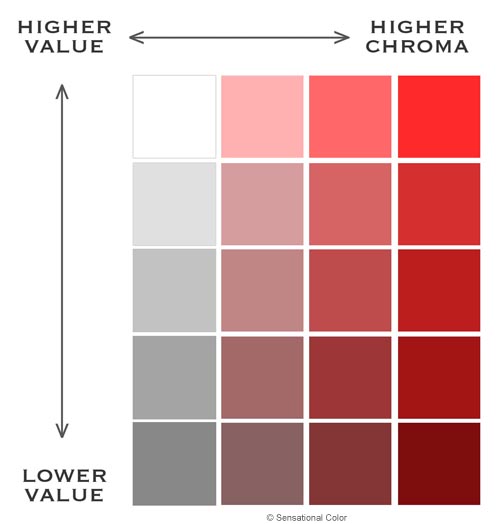
The value or luminosity of a colour represents its grade of clarity or darkness. Clarity is
obtained by adding white to a tone and darkness by adding black. When a tone has a lot of white,
it has a high value. If it has a lot of black, it has a low value.

• Saturation

Saturation refers to the grade of purity, vivacity or intensity of a colour. Primary and secondary
colours are pure colours, they have a maximum grade of saturation.
Both in nature and in graphic reproductions colours rarely appear with their maximum grade
of saturation. Normally they are complex mixes of colours with their respective complementary
colours.
The more complementary colour in the mix, the less saturation the original colour will have.

Perception of colour
Our sight can perceive the same colour in a different way depending on lighting, the space it
occupies or the colours that surround it. 

The Colour range

A colour range orders colours according to their value, saturation or the position of their tones in
the colour wheel.
• Cold range: Tones that go from green to purple. Blue is the coldest colour.
• Warm range: Tones that go from magenta to greenish yellow. Red is the warmest colour.

Expressiveness of colour schemes

Cold colours are associated with calm, or seriousness and warm colours with joy, or aggressiveness.
Achromatic scheme
This range uses black and white, that, in different proportions, give different values of clarity and
darkness. This range is cold.
Polychrome and monochrome
Polychromatic images have two or more colours, with different values and saturation.
Monochrome images have a single colour and different values.

Colour harmonies
Combining colours is called harmonising. We harmonise related colours, complementary colours and colours with black and white, creating greys.
Related colour harmonies
Using neighbouring colours in the colour wheel creates a harmony of related colour.
Contrasting colour harmonies
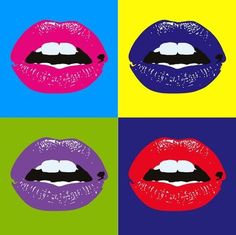
To separate forms, we use colours that contrast in the colour wheel. For example, magenta and green. This creates a harmonious contrast.

Harmony of greys
By mixing colours with black and white, we obtain a harmony of greys. Similar colours produce a harmony of similar greys.
Complementary colours, produce a harmony of complementary greys.

http://www.slideshare.net/darakeyla/cool-and-warm-colors

Try this link, there you´d find  more information about colours... 

And a web page  Color in motion


Exercises

True or false? Correct the false sentences.
1. Colours have five characteristics.
2. Hue, tone and tint refer to the name of the colour.
3. Value is the luminosity of a colour.
4. Value represents the amount of water in a colour.
5. A tone with a lot of white, has a low value.
6. A tone with a lot of black, has a low value.
7. Only primary colours are pure colours.
8. We always perceive colours in the same way.

Complete the spaces.

1. Colour is an element of … language.                       a) visual         b) oral
2. There are … primary colours.                                  a) two             b) three
3. Primary colours are … by mixing other colours.     a) obtained     b) not obtained
4. Red, green and violet are … colours.                       a) secondary   b) primary
5. Mixing all the primary colours produces…             a) near white.  b) near black.
6. Subtractive colour mixing implies that
 each added colour…   luminosity.                               a) adds luminosity. b) subtracts
                                                                                                      
7. The colour wheel helps us to sort … colours.          a) primary   b) primary and secondary
8. Yellow is complementary to violet because
 it ….colours that form violet.                                      a) contains       b) doesn’t contain
                                                                                                   

Work in pairs. Discuss these questions with your partner.

- Look at the following images, which feelings do 
they transmit to you?


- 


miércoles, 20 de abril de 2016


Cartel conmemorativo del cuarto centenario de la muerte de Miguel de Cervantes


Aula Planeta nos sugiere estos diez recursos para descubrir a Cervantes...


Cervantes2


Miguel de Cervantes, considerado universalmente el creador de la novela moderna, y exponente del Siglo de Oro español, está de actualidad porque este año se conmemora el cuarto centenario de su muerte e, incluso, por el hallazgo de parte de sus restos en la iglesia de las Trinitarias de Madrid. Sin embargo, más allá del misterio de su tumba, su legado literario está a la vista de todos: a su obra maestra, El Quijote, cuya segunda parte también cumple 400 años, se suman otras novelas, teatro y poesía. Te proponemos diez recursos digitales para que descubras la vida y la relevancia literaria de Cervantes a tus alumnos con la ayuda de las nuevas tecnologías.


DIEZ RECURSOS SOBRE CERVANTES


Las siguientes propuestas repasan la biografía de Cervantes, sus obras y su importancia en el desarrollo de la literatura moderna.


1. Las obras de Cervantes, online. La web del Proyecto Gutenberg recopila versiones en multitud de idiomas de varios libros cervantinos. En esta web también las encontrarás en español, junto con información del autor.
2. Minisite sobre Miguel de Cervantes. Elaborado por la Biblioteca Virtual del Instituto Cervantes, este espacio web incluye información muy completa sobre el autor. Destaca la fonoteca, con grabaciones de algunas de sus obras, la videoteca con comentarios de expertos y el amplio listado de filmografía recomendada. Puedes completarla con la sección dedicada a El Quijote.
3. La vida de película de Miguel de Cervantes. Reportaje en el que se repasan las sorprendentes aventuras y desventuras del “Manco de Lepanto” en la batalla homónima y se explica cómo estas vivencias pueden ayudar a identificar sus huesos.
4. La narrativa en los Siglos de Oro. Sencilla aplicación online con datos sobre la novela del siglo XVI, Cervantes y El Quijote. Además de proporcionar un contexto al autor, incluye actividades tipo test para comprobar los conocimientos adquiridos.
5. Edición original de El Ingenioso Hidalgo Don Quijote de la Mancha. Esta versión virtual de la Biblioteca Nacional de España ofrece la posibilidad de hojear la obra tal como se publicó por primera vez en Madrid entre 1605 (primera parte) y 1615 (segunda parte).
6. En un lugar de la red. Aplicación interactiva multimedia pensada para estimular la lectura de El Quijote, con información de contexto, varios capítulos online, datos sobre la obra, actividades y juegos. Incluye guía de uso y guía didáctica.
7. Don Quijote de La Mancha. Completa web educativa dedicada al Ingenioso Hidalgo, con recursos, actividades, juegos, cómics, actividades…
8. Aprende y diviértete con El Quijote. Minisite con cuatro aventuras animadas y juegos para practicar lengua y matemáticas con el famoso libro de Cervantes.
9. Cincuenta preguntas sobre El Quijote y Miguel de Cervantes. Reportaje de El País con curiosidades sobre la vida y la obra de Cervantes.
10. Serie de televisión El Quijote. RTVE te ofrece todos los capítulos de esta mítica serie, dirigida por Manuel Gutiérrez Aragón, con guion de Camilo José Cela y protagonizada por Fernando Rey y Alfredo Landa. También se está preparando una ficción sonora sobre El Quijote para radio, que podrá escucharse aquí.


- See more at: http://www.aulaplaneta.com/2015/04/23/recursos-tic/diez-recursos-para-descubrir-la-figura-de-cervantes-tus-alumnos/index.html#sthash.igvrC0iJ.dpuf


domingo, 17 de abril de 2016

TERCERA EVALUACIÓN


En esta evaluación desarrollaremos nuestros conocimientos en Geometría, en concreto Polígonos, Tangencias y Movimientos en el Plano.
Los apuntes de estas unidades los podrás encontrar siguiendo este enlace  Geometría, del blog Las Láminas, donde podrás encontrar  la teoría muy bien explicada, ejemplos claros y sencillos, así como los ejercicios que vamos a tratar en clase.

This term we will develop our knowledge in geometry, specifically Polygons, Tangencies and Planar geometric transformations.
The notes of these units can be found by following this link geometry, the blog Las láminas, where you can find explained the theory , clear and simple examples and exercises that will try in class.


domingo, 14 de febrero de 2016

Comic Strips


  1. GIVING EXAMPLES


Calvin and Hobbes is unquestionably one of the most popular comic strips of all time. (A comic strip is a series of drawings used to tell jokes.) It’s about the adventures of Calvin, a six-year-old with an overactive imagination, and Hobbes, his stuffed toy tiger.

Words to Know

·Wanders (panel 1) — To walk slowly and casually.
·African plain (panel 1) — A plain is a large flat area of land.
·Ton (panel 2) — 2,000 pounds or about 900 kilograms.
·Deafening (panel 3) — A sound so loud that it will make you deaf.
·Shatter (panel 3) — To break violently into pieces.

 
Strips like these are what make Calvin and Hobbes so much better than other comics. Here, we explore Calvin imagining himself as an elephant innocently wandering through the African plains only to find out what he’s actually doing in the final panel: being a mischievous (i.e. someone who likes to cause trouble in a playful way) little boy, pulling a prank (i.e. a practical joke) on his parents.

Words to Know

·Who knows? (panel 2) — This is used to imply that you don’t know the answer to the question and don’t really care. For example: What are the characters’ names on the reality TV show Jersey Shore? —Who knows?
·Who cares? (panel 3) — You say who cares? when you want to imply that you don’t care at all, and you don’t think anyone else does either.
 

This panel begins to introduce the character Susie, who Calvin likes but tries to cover it up (cover it up means to hide) by always doing mean things and making fun of her. (You can see a full length cartoon with her at the end of the article.)

Words to Know

·Set fire (panel 1) — to intentionally put something on fire. You can also say to set something on fire or to light something on fire.
·She’s on to me (panel 4) — When someone is on to you they know what you’re thinking, they understand your intentions.


Here Calvin is asking absurd requests of his mom in order to make the question, “Can I have a cookie?” not seem so bad. However, this plan doesn’t work which leads Calvin to think “She’s on to me.”

Words to Know

·Utterly (panel 3) — completely.
·Cynically (panel 3) — doubtful as to whether something is worthwhile.
·Lousy (panel 4) — very bad.


Bill Watterson is criticizing the U.S.’s public education systems, saying how they only teach children to memorize useless information instead of teaching them anything useful, worthwhile, or practical.

Words to Know

·Words fail me (panel 4) — I’m speechless (without words), words can’t describe how I feel, I can’t think of anything to say.
·Keep in mind (panel 4) — Remember.
·Transmogrification (panel 4) — To transform into a different shape, especially something that is unusual or strange.

This strip introduces a long line of jokes as Calvin as a tiger.

Words to Know

·Go into shock (panel 1) — When blood pressure drops too low to get enough blood to your body. Symptoms include cold yet sweaty skin, weak and rapid pulse (how fast your heart beats).
·Scam (panel 2) — Fraud, a dishonest scheme
·Deadman’s float (panel 3) — When you float on your back in the water. 

This panel is making fun of little suburban kids who are forced to take swimming lessons against their will and are irrationally (i.e. unreasonably) afraid of them.

Words to Know

·Trick question (panel 4) — Trick questions are when someone asks a question they already know the answer to in order to confuse someone. The question can have no correct answer or when the answer is no as simple as it seems.
For example, the initial response to What do you put into a toaster? is toast, which is incorrect. You put bread into a toaster and it turns into toast.


A great strip that just shows Calvin just being a kid. The mom has a normal reaction, “What are you doing?!” and Calvin thinks the answer is pretty obvious…

Words to Know 

·A man of few words (panel 1) — Someone who is able to make a point without needing to use a lot of words. Someone who can describe things well. It’s usually used as a compliment.

Here you get a glimpse of Hobbes’ “smart-ass” (i.e. sarcastic) humor. Calvin says with dignity (as you can tell by the expression on his face), that he is “a man of few words,” which Hobbes makes it into meaning that Calvin doesn’t know many words and therefore isn’t very smart.

Words to Know

·Seeks (panel 1) — Is looking for.
·Euphoria (panel 2) — A feeling of intense excitement and happiness.
·At a loss for words (panel 4) — This means to have nothing to say, to be speechless.
·…Many a friendship (panel 4) — Hobbes is saying that his silence has prevented many people from disliking him.

Here, Calvin is making some absurd statements that Hobbes prefers to not to comment about. When Calvin makes fun of him for it, Hobbes implies if you don’t have anything nice to say, don’t say anything at all. This strip shows Hobbes as a man of few words.

Words to Know

·Fold (panel 4) — Fold is the word you say in poker when you want to quit on “the hand,” or throw your cards away and not bet anymore money on the round.
Notice Hobbes’ tail in the third panel.

Words to Know

·Patient (row 1, panel 2) — Someone who is waiting to see a doctor.
·Tongue depressor (row 1, panel 2) — A device used to examine the mouth and throat.
·Like I care (row 2, panel 1) — A sarcastic way to say that you don’t care at all.
·Find out (row 2, panel 2) — Issue a warning.
·Psychosomatic (row 2, panel 3) — A physical illness caused by mental problems.
·Lobotomy (row 2, panel 3) — A type of brain surgery, often used for mental patients.
·Saw (row 2, panel 3) — A big, knife-like tool used to cut down trees, among other things.
·Stethoscope (row 2, panel 3) — A medical tool used to listen to a heartbeat or breathing, it’s often worn around a doctor’s neck.
·Mallet (row 2, panel 4) — A hammer with a large wooden head.
·Anesthesia (row 2, panel 4)— A drug used to dull pain in medical procedures.
·Shot (row 3, panel 1) — To receive a vaccination through an injection.
·Shot in the mouth (row 3, panel 1) — A punch in the mouth.


Calvin and Hobbes include many brilliant strips like these showcasing the imaginative power of little kids (i.e. children). In the beginning of the strip, Calvin and Susie appear to be an adult doctor and his patient, respectively. But as the comic continues, you notice how childish/immature the adults are acting, only to find towards the end of the comic that the adults are actually Calvin and Susie playing Doctor.

 In this frame from a comic, a visual metaphor is used. What is it?


ACTIVITIES


This activity requires student collaboration and creativity.
1. Make enough copies of the comic strip for your students.
2. Cut it up in frames.
3. Give a set to each pair/group.
4. Students work in pairs and organize the frames in sequence.
5. Students write the lines for each balloon.
6. Students share their stories.
7. Students check the original sequence.
8. Students compare their stories to the original comic strip.
9. Students choose the story they like the most.


This is an activity for conversation time in class.
1. Students dicuss the questions in small groups.
2. Individual work: Students complete the comic strip with the past tense of the verbs.
3. Peer check: Students chech their answers in pairs.
4. Show the slide and check with the whole group.
5. Pair work: Students read the comic strip and discuss the questions in pairs.
6. Homework: web search.


This is a reading activity that also promotes language awareness. Students have to analyse the language so as to be able to organize the frames into the original cartoon.
1. Make as many copies of the cartoon as necessary.
2. Cut the it up in frames.
3. Give a set to each pair/group.
4. Students work together to organize the frames.
5. Check their work.

Then have a class discussion:
a) What helped you identify the sequence of the story?
b) Which words were they?
c) Which words can you use to help you organize a sequence of events? Make a list of them.
d) Now write a story using these words to organize it.


Diferents comic strips


1. Match the following sentences to the onomatopoeia that describes them.
A plate being dropped on the floor.
TINKLE
A balloon being burst.
BANG
A gun being shot.
SMASH
Someone eating crisps.
GROWL
A light being switched on.
POP
A fierce dog.
CRUNCH
A small bell being rung.
CLICK

2. Put each onomatopoeia into a sentence.

a Ouch! b Hmmm c Shhh… d Hah! e Mmmmm
f Oops! g Ah hah!!! h Phew! i Whew! j Splash
1 You are cheating at a test and you see the teacher coming in your direction.
2 You finally understand something.
3 You’re eating a delicious piece of cake.
4 Your friend takes off his smelly shoes.
5 You’re watching TV and you want everyone to be quiet.
6 You drop a baloon full of water on the floor
7 You get a test back. You needed 12 to pass, you thought you failed but you got 13.
8 You dropped a heavy book on your foot.
9 You find out that you were right and your friends were wrong.
10 You are thinking about something. (Let me see…)


domingo, 10 de enero de 2016

Apuntes de Geometría


Os recomiendo un enlace muy bueno donde podréis encontrar explicaciones detalladas de los ejercicios que os propongo en clase... No es que tengáis que hacerlos todos sino que es una página muy completa llena de ejemplos y ejercicios útiles.


Os la respondo las dudas  en clase. Si por alguna razón no podéis imprimirlas, o verlas, os puedo dejar las copias o fotocopiarlas en Conserjería.

viernes, 20 de noviembre de 2015

EDUCACIÓN PLÁSTICA Y VISUAL, 3º

Hola chicos/as de Tercero de ESO

Retomo la publicación de los apuntes y recursos que os expongo en el aula para que dispongáis de ellos libremente y con responsabilidad, y así mejorar nuestro trabajo en el aula de Plástica -Visual Arts. Seguro que os van a venir muy bien.
Recordad que los ejercicios que se os proponen en el aula son obligatorios;  procuraré publicarlos en la mayor brevedad posible para que podáis resolver dudas, o ampliar conocimientos, y sigo ahí para aclararos, o...liaros más.

Los ejercicios corresponden con lo programado para vuestro curso. Ya sabéis que la buena ejecución, limpieza y presentación adecuada, son obligatorios,ya sean trabajos de geometría, dibujo libre y/o de la técnica artística que sea.. No dudéis en preguntarme.

Os recuerdo :
     - Los trabajos deben entregarse en carpeta o funda transparente, en la fecha que acordemos, y siempre en papel adecuado, tipo BASIC o vuestro bloc de dibujo. Si imprimís alguno de los ejercicios propuestos, debéis hacerlo utilizando dicho papel en vuestra impresora o pedid que os lo impriman en conserjería (os dejaré un enlace...).
   - Poned siempre nombre y apellidos, curso y título de la lámina....ya nos conocemos todos y sabemos lo que hace cada uno...pero os conviene estar preparados y hacer las cosas bien, aunque sean sencillas, todo vale algún día!
- Todos los trabajos se valoran, estén o no hechos, así que procurad hacerlos todos para que compensen las notas y hacedlos bien para que seamos justos...